
Tankless Water Heater Guide: Endless Hot Water Explained
Discover how a tankless water heater provides endless hot water, saves energy, and frees up space. Learn key benefits and considerations for your home upgrade.
By Alexia Mabel
Learn more about Water Heater Installation or Replacement for guides, costs, and what to expect.
Compare Water Heater Installation or Replacement Pros Near You

Enter your ZIP code to compare top-rated local professionals and request free quotes.
Have you ever been the last one to shower, only to be greeted by a blast of cold water? Or do you dread opening your utility bill each month, watching energy costs climb? For many homeowners, the traditional storage tank water heater is a source of frustration, inefficiency, and unexpected cold showers. There’s a modern solution that solves these problems by heating water on-demand, providing comfort and savings for years to come.
Ready to upgrade to endless hot water and energy savings? Call 📞833-700-4293 or visit Calculate Your Savings today for your free, no-obligation consultation.
What Is a Tankless Water Heater?
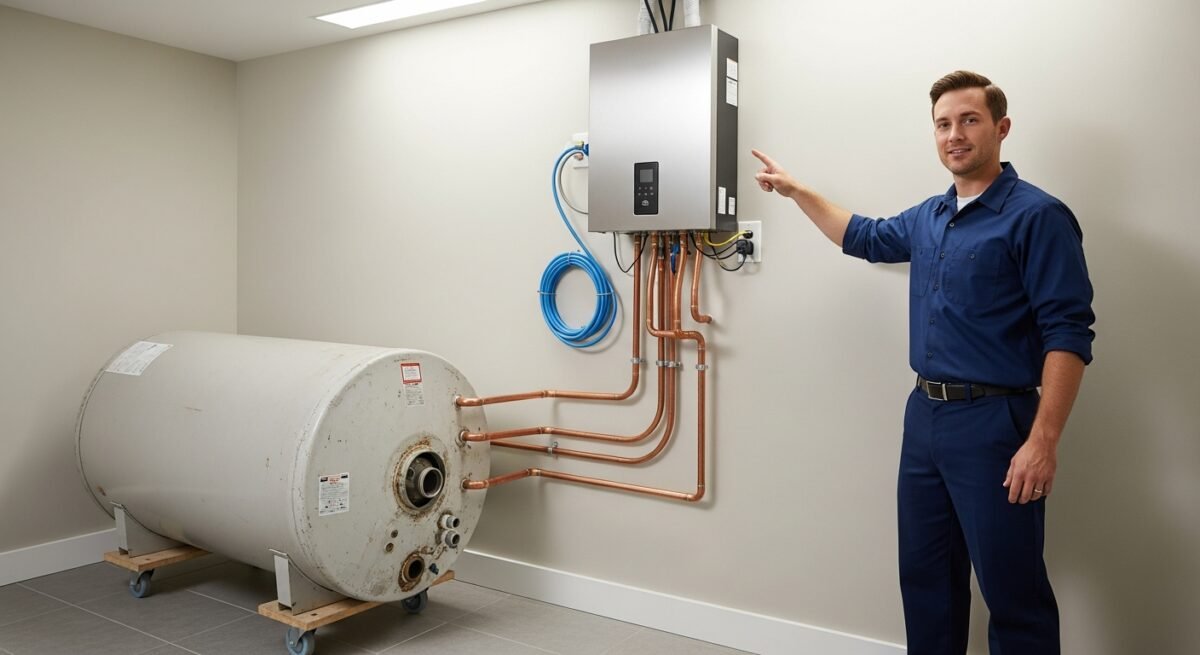
A tankless water heater, often called an on-demand or instantaneous water heater, is a compact unit that heats water directly as it flows through the device. Unlike a traditional tank that constantly heats and reheats 40-80 gallons of stored water, a tankless system activates only when you turn on a hot water tap.
Cold water travels through a pipe into the unit, where either a powerful gas burner or an electric heating element instantly warms the water to your preset temperature. This means you get a continuous supply of hot water for as long as you need it, without waiting for a storage tank to refill and reheat.
How the Technology Works
The core principle is simple: heat water only when you need it. A flow sensor inside the unit detects when a hot water tap is opened. This triggers the system to ignite the burner or engage the heating element. Heat exchangers then rapidly transfer energy to the flowing water, delivering it to your faucet or shower in seconds.
Why It Matters for Homeowners
Upgrading to a tankless water heater isn’t just about avoiding cold showers; it’s a strategic home improvement that impacts your daily life, finances, and even your home’s footprint. The benefits are substantial and tangible from the very first day.
First, you gain the convenience of endless hot water. This is perfect for families, allowing for back-to-back showers, running a dishwasher, and doing laundry without compromise. Second, and often most appealing, are the significant energy savings. The U.S. Department of Energy estimates that for homes using 41 gallons or less of hot water daily, tankless heaters can be 24-34% more energy efficient than conventional storage tank models.
Beyond savings and convenience, tankless units free up valuable floor space, last nearly twice as long as tank models, and reduce the risk of catastrophic water damage from a tank rupture. For a deeper look at maintaining any water heater system, our expert water heater repair guide offers valuable insights.
Common Issues and Their Causes
While tankless water heaters are renowned for their durability, they are sophisticated appliances that require proper installation and periodic maintenance. Understanding common issues can help you prevent them and know when to call a professional.
Many problems stem from mineral buildup, especially in areas with hard water. Limescale can coat the internal heat exchanger, reducing efficiency, causing strange noises, and even leading to overheating and system shutdowns. Another frequent issue is an error code due to improper venting, insufficient gas supply, or a clogged air intake filter.
- Fluctuating Water Temperature: Often caused by a undersized unit, a clogged filter, or a faulty flow sensor.
- System Won’t Ignite: Can be due to a lack of gas/power, improper venting, or a failed ignition component.
- Reduced Hot Water Flow: Typically points to mineral scale restricting internal waterways or a clogged inlet screen.
- Error Codes/Lockout: The unit’s self-diagnostic system detecting a fault like a flame failure or overheat condition.
How Professionals Fix the Problem
Professional repair and maintenance follow a systematic approach to ensure your tankless system operates safely and efficiently. It always begins with a diagnosis, often using the unit’s error code display as a starting point.
A technician will then perform specific tests and inspections. For a descaling service to combat hard water, the process involves isolating the unit, circulating a descaling solution through the heat exchanger to dissolve mineral deposits, flushing the system, and then reinstalling it. This is a critical maintenance task best left to pros with the right equipment and solutions.
For other repairs, such as replacing a flow sensor, gas valve, or fan, the technician will safely disconnect utilities, swap the faulty component with a manufacturer-approved part, reassemble the unit, and test its operation under load to ensure it’s working perfectly. Proper installation is key to avoiding future issues, as outlined in our comprehensive expert water heater repair guide.
Signs You Should Not Ignore
Your tankless water heater will often give you clear warnings before a complete breakdown occurs. Paying attention to these signs can save you from an unexpected cold shower and more costly repairs down the line.
Listen to your unit. Unusual sounds like kettling (a rumbling or knocking) are a classic sign of limescale buildup. If you notice a sudden drop in water pressure from your hot water taps, or if the water temperature fluctuates wildly during use (lukewarm to scalding), your system needs attention.
- Error Codes Flashing: Never ignore the system’s own diagnostic warnings.
- No Hot Water: Check that the unit has power/gas first, but if it does, a professional is needed.
- Discolored or Smelly Water: Could indicate a failing heat exchanger or bacterial growth.
- Increased Energy Bills: A gradual loss of efficiency often means it’s time for maintenance.
Cost Factors and What Affects Pricing
The cost of a tankless water heater project varies based on several key factors. Being aware of these will help you understand quotes and make the best decision for your home and budget.
Ready to upgrade to endless hot water and energy savings? Call 📞833-700-4293 or visit Calculate Your Savings today for your free, no-obligation consultation.
The unit itself is a major factor. Gas models (both natural gas and propane) generally cost more than electric models but often have a higher flow capacity. The size, measured in gallons-per-minute (GPM) and temperature rise, must match your household’s peak demand. The biggest variable, however, is often the installation complexity.
If you’re switching from a tank-type system, installation may require upgrading gas lines, electrical service, or venting materials. These necessary upgrades ensure safety and performance but add to the initial project cost. Remember, a proper installation by a qualified professional, as we detail in our expert repair and installation guide, is an investment that pays off in reliability and longevity.
How To Choose the Right Professional or Service
Selecting the right installer is as crucial as choosing the right unit. A poor installation can void warranties, create safety hazards, and lead to persistent performance problems.
Always look for a licensed, bonded, and insured contractor who specializes in plumbing and gas lines. Ask about their specific experience with tankless systems—how many they install per year and if they are certified by major brands. A reputable professional will always perform a thorough home assessment before giving a quote, checking your current plumbing, gas, and electrical capacity.
Be wary of the lowest bid if it seems too good to be true. A proper installation includes permits, high-quality materials, and a final inspection. Ask for references and read reviews to gauge their reputation for quality work and customer service.
Long-Term Benefits for Your Home
Investing in a tankless water heater delivers advantages that compound over time. The higher initial cost is offset by years of reliable performance and savings.
You’ll enjoy consistent energy savings for the life of the unit, which can be 20 years or more—double that of a standard tank. You’ll reclaim valuable square footage in your utility room or basement. Most importantly, you gain peace of mind. The risk of a leaking, flooding tank is eliminated, and you’ll have a dependable source of hot water that supports your family’s lifestyle for decades, adding both comfort and value to your home.
Frequently Asked Questions
How long does a tankless water heater last?
With proper maintenance, a tankless water heater can last 20 years or more. This is significantly longer than the 10-15 year average lifespan of a traditional tank-style heater.
Can a tankless water heater run out of hot water?
No, a properly sized tankless heater provides a continuous flow of hot water on demand. However, if the demand exceeds the unit’s flow rate capacity (like running multiple showers simultaneously), the water temperature may drop.
Do tankless water heaters need maintenance?
Yes, annual maintenance is recommended, especially in hard water areas. This typically involves descaling the heat exchanger and cleaning filters to maintain efficiency and prevent damage.
Are tankless water heaters more expensive to install?
The upfront installation cost is usually higher than for a tank heater, primarily due to potential needs for upgraded gas lines, vents, or electrical circuits. This cost is often recouped over time through energy savings.
Can I install a tankless water heater myself?
It is strongly discouraged. Installation involves complex plumbing, gas, and electrical work that must meet strict local codes. Improper installation can be dangerous, void warranties, and lead to poor performance.
How do I know what size tankless heater I need?
A professional will calculate based on your home’s peak hot water demand (simultaneous uses) and the groundwater temperature in your area. This determines the required flow rate (GPM) and necessary temperature rise.
Do electric tankless water heaters work as well as gas?
Electric models are very effective and efficient but often have a lower flow rate than gas models. They are excellent for point-of-use applications or homes with lower simultaneous hot water needs.
What is the biggest drawback of a tankless water heater?
The primary drawback is the higher initial purchase and installation cost. There can also be a short delay (a few seconds) for hot water to reach distant faucets, which can be mitigated with a circulation system.
Upgrading to a tankless water heater is a smart, long-term investment in your home’s efficiency, comfort, and value. By understanding how the system works, recognizing when it needs care, and partnering with a qualified professional for installation and maintenance, you can enjoy endless hot water and lower energy bills for many years to come.
Ready to upgrade to endless hot water and energy savings? Call 📞833-700-4293 or visit Calculate Your Savings today for your free, no-obligation consultation.
Learn more about Water Heater Installation or Replacement for guides, costs, and what to expect.
Compare Water Heater Installation or Replacement Pros Near You
Enter your ZIP code to compare top-rated local professionals and request free quotes.