
Smart Home Energy Management System Planning Guide
Plan a smart home energy management system before walls close. Call (833)-700-4293 to compare independent local providers and avoid costly retrofits.

By Eric Andrew
Learn more about Smart Home Installation or Repair for guides, costs, and what to expect.
Compare Smart Home Installation or Repair Pros Near You

Enter your ZIP code to compare independent local professionals and request free quotes.
Your energy bill keeps climbing, and you have a vague sense that a smart home energy management system could help. But where do you start when the walls are still open, the electrician is asking for decisions, and every device seems to speak a different language? Smart home energy management system planning is not about buying the most gadgets. It is about designing a coordinated setup that monitors, controls, and reduces energy use without creating a patchwork of incompatible apps. Get the plan right before drywall goes up, and you avoid costly retrofits later. Get it wrong, and you end up with orphaned devices and a system that saves less than promised.
This guide walks through the practical decisions homeowners face during a remodel or upgrade. You will learn which components matter, how to plan wiring and placement, what compatibility questions to ask, and how to set realistic expectations for savings. You will also see where independent local providers fit into the process, and how to compare quotes with confidence. Whether you are finishing a basement, remodeling a kitchen, or rewiring an older home, a thoughtful energy management plan turns a tangle of smart devices into a system that actually works.
What a Smart Home Energy Management System Actually Includes
A smart home energy management system is a set of connected devices and software that helps you see, control, and reduce electricity and gas consumption. It is not a single product. It is an ecosystem that typically includes smart thermostats, energy monitors, load control switches, smart plugs, and a central app or hub that ties everything together. Some systems also integrate solar inverters, battery storage, EV chargers, and smart lighting. The goal is to give you visibility into where energy goes and the ability to automate decisions that lower waste.
The core components fall into four functional groups. Understanding these groups helps you plan a system that scales with your needs rather than locking you into one brand or one narrow use case.
- Climate controls: Smart thermostats and zone controllers that adjust heating and cooling based on occupancy, schedules, and weather. These often deliver the fastest and most noticeable savings.
- Monitoring and metering: Whole-home energy monitors and circuit-level sensors that track consumption in real time. They reveal which appliances or circuits drive your bill.
- Load controls: Smart switches, relays, and plugs that can shed or shift loads such as water heaters, pool pumps, and EV chargers. These are essential if you want to avoid peak-demand charges or coordinate with solar production.
- App and platform layer: The hub, cloud service, or local controller that unifies devices and enables automation. This layer determines how well your system works together and how much data you can access.
Each group has different wiring and placement needs, which is why planning before construction matters. A thermostat needs a C-wire or a compatible power solution. A whole-home monitor needs space in the main electrical panel. Load controls need to be installed at the circuit level, often inside the panel or in a nearby junction box. The app layer depends on reliable Wi-Fi or a wired network backbone. If you treat these as afterthoughts, you will pay more to retrofit them later.
Planning Wiring and Device Placement Before the Walls Close
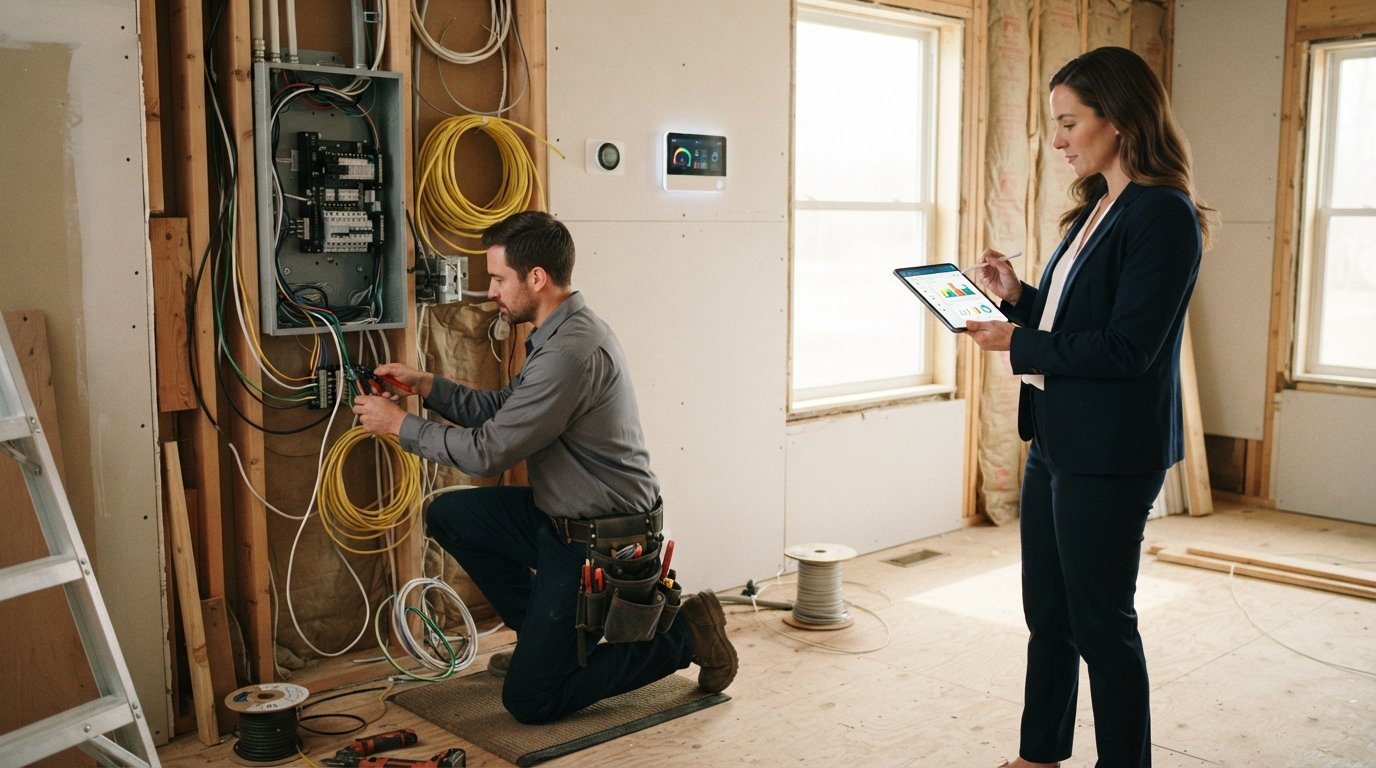
The single most important rule of smart home energy management system planning is to decide on infrastructure before rough-in. Once drywall is up and painted, adding a dedicated circuit or a low-voltage wire becomes a demolition project. During a remodel, you have a rare opportunity to run cables, add boxes, and create pathways at a fraction of the cost. Even if you do not install every device immediately, planning for future needs is smart.
Start with the electrical panel. A whole-home energy monitor typically requires space for current transformers around the main service conductors. If your panel is full or aging, this is the moment to discuss an upgrade with your electrician. Panel capacity also affects load controls and any future EV charger or heat pump water heater. Ask your provider to assess panel capacity and spare breaker slots early in scoping. A few hundred dollars of planning now can prevent a service upgrade later.
Next, map device locations room by room. Thermostats belong on interior walls away from direct sunlight, drafts, and heat-producing appliances. Energy monitors live at the panel. Smart switches go in standard wall boxes, but some load-control relays need deeper boxes or dedicated enclosures. If you plan to add circuit-level monitoring, decide which circuits matter most, such as HVAC, water heater, kitchen appliances, and EV charging. Not every circuit needs a sensor, so prioritize the loads that drive your bill.
Network infrastructure is the quiet hero of any energy management plan. Many devices rely on Wi-Fi, but a mesh system or wired access points reduce dropouts and keep automations reliable. If you are remodeling, consider running Ethernet to key locations such as a utility closet, home office, and media area. A wired backbone also supports local control hubs that keep automations running when the internet is down. During renovation, it is also wise to plan for smart home wiring upgrades that support future devices, from motorized shades to security sensors. Our guide on smart home wiring upgrades during renovation explains how to future-proof low-voltage pathways without overbuilding.
Finally, document your plan. Create a simple diagram showing the panel, monitor location, thermostat locations, network equipment, and any load-control points. Share it with every provider who touches the project. Clear documentation prevents miscommunication between the electrician, HVAC contractor, and low-voltage installer, and it gives future owners a roadmap of the system.
Compatibility Questions to Ask Before You Commit
Compatibility is where smart home energy management system planning often goes wrong. A thermostat from one brand, a monitor from another, and a hub from a third may not talk to each other. The result is multiple apps, limited automation, and a system that saves less than expected. Before you buy anything, ask a short set of questions that reveal how well devices will work together.
First, ask which platforms each device supports. Look for major ecosystems such as Matter, Zigbee, Z-Wave, Wi-Fi, and Thread. Matter is designed to improve cross-brand compatibility, but not every device supports it yet. If a device only works with a proprietary cloud, you are dependent on that company staying in business and keeping its servers online. Local control options, such as hubs that run automations on-site, are more resilient.
Second, ask about data access and export. A good energy monitor lets you download usage data and integrate it with other tools. If the data stays locked in a vendor dashboard, your ability to analyze and optimize is limited. Third, ask about power and wiring requirements. Some smart thermostats need a C-wire, some can use a power adapter, and some rely on batteries. Load-control relays may require a neutral wire in the switch box, which older homes often lack. Knowing this before rough-in avoids surprises.
Fourth, ask how the system handles software updates and end-of-life. Smart devices are computers, and they need updates to stay secure and functional. A provider should be able to explain the update process and what happens if a device is discontinued. Finally, ask about interoperability with solar and EV charging if those are in your plans. An energy management system that cannot coordinate with your solar inverter or EV charger leaves savings on the table. A short compatibility checklist can save hours of frustration:
- Which wireless protocols and platforms does the device support?
- Does it require a neutral wire, C-wire, or dedicated circuit?
- Can I export my data, and does it integrate with other systems?
- Does it work locally if the internet goes down?
- How are firmware updates handled, and what is the support policy?
Use these questions during scoping with independent local providers. They will help you compare quotes on more than price, and they will reveal whether a provider understands integrated systems or only installs single devices.
What to Discuss With Independent Local Providers During Scoping
Smart home energy management system planning works best when you treat providers as partners in design, not just installers. During scoping, bring your goals, your floor plan, and your compatibility questions. Explain what you want to monitor, control, and automate. Be specific about priorities: Is your main goal lowering heating and cooling costs, tracking appliance usage, preparing for solar, or all of the above? Providers can then recommend a sequence that fits your budget and construction timeline.
Ask each provider how they handle coordination between trades. Energy management touches electrical, HVAC, networking, and sometimes plumbing for water heaters. A good provider will explain who runs low-voltage wiring, who installs the monitor, and who configures the app. If multiple trades are involved, confirm who is responsible for testing the system end to end. You do not want to discover after final payment that the thermostat and the monitor were never integrated.
Also discuss the scope of configuration. Some providers install hardware and leave app setup to you. Others offer a walkthrough and basic automation setup. Clarify what is included. If you want advanced automations, such as shifting water heating to solar hours or setting vacation modes, ask whether that is part of the quote or a separate service. Finally, ask about documentation and training. A short handover session and a labeled panel schedule are worth more than a box of manuals.
When comparing quotes, look beyond the bottom line. A low quote that excludes wiring, configuration, or permits may cost more later. A higher quote that includes design, coordination, and commissioning may deliver better results. If you want help finding independent local providers for electrical, HVAC, and smart home work, a free matching service can simplify the process. For homeowners who prefer to compare options without pressure, 180Remodel connects you with independent third-party providers across a wide range of home improvement projects, and you can request quotes with no obligation. Use it to gather multiple perspectives before you commit to a design.
Realistic Expectations for Tracking and Reducing Energy Use
Smart home energy management system planning should include a candid conversation about savings. Marketing materials often promise dramatic reductions, but real results depend on your home, your habits, and your rates. Smart thermostats and load controls can deliver meaningful savings, especially in homes with inefficient scheduling or high peak-demand charges. But savings are rarely automatic. They come from using the data and automations consistently.
Expect the first month to be about baselining. A whole-home monitor shows you when and where energy is used. You may discover that a second refrigerator, an old pool pump, or standby loads are costing more than expected. Circuit-level monitoring can pinpoint the culprits. Once you have a baseline, you can set targets and automate changes. A realistic goal is a gradual reduction over several months, not a dramatic drop in the first week.
Also plan for seasonal variation. Heating and cooling dominate most bills, so savings from thermostat scheduling will vary by season. Load controls that shift water heating or EV charging to off-peak hours can produce steady savings if your utility offers time-of-use rates. If you have solar, coordination between production and consumption matters more than raw reduction. An energy management system that schedules loads around solar production can increase self-consumption and reduce grid draw.
Finally, build in a review cadence. Check your dashboard monthly, adjust automations seasonally, and update your plan when you add devices or change rates. Smart systems reward attention. A plan that includes a simple quarterly review will outperform a set-and-forget installation. And if you are planning a larger remodel, consider how energy management fits into the broader project scope. A free matching service can help you compare quotes from independent local providers for the electrical, HVAC, and smart home work involved, so you can move forward with a coordinated plan rather than a collection of disconnected devices.
Smart home energy management system planning is ultimately about making deliberate choices before construction forces your hand. Decide on components, map wiring and placement, ask compatibility questions, and set realistic savings goals. Work with independent local providers who understand integration, and document everything. Do this, and your system will not just be smart. It will be genuinely useful, saving energy and money for years to come.