
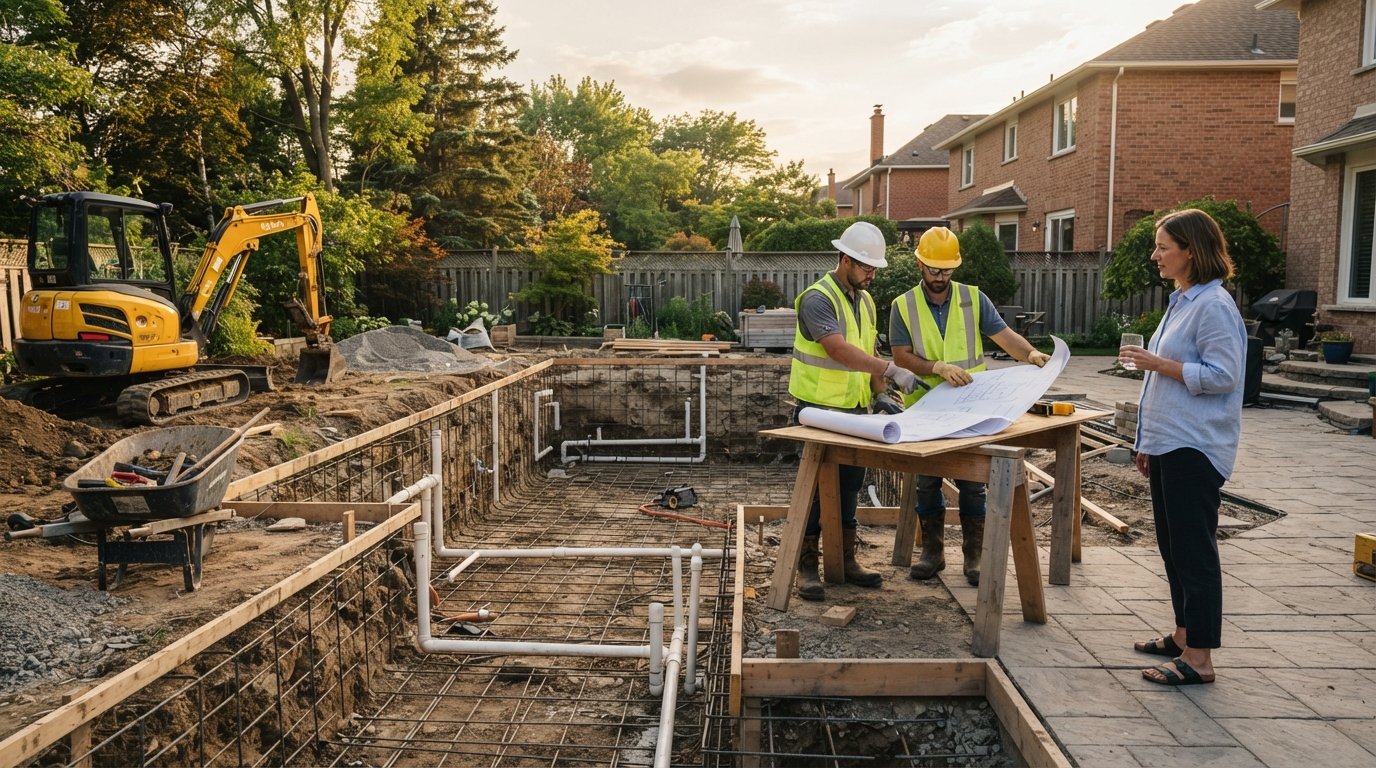
In Ground Swimming Pool Installation Cost Breakdown
Get a complete in ground swimming pool installation cost breakdown, from excavation to fencing and energy bills. Call (833)-700-4293 for contractor quotes.
By Peter Hubert
Learn more about In-Ground Swimming Pool Construction for guides, costs, and what to expect.
Compare In-Ground Swimming Pool Construction Pros Near You

Enter your ZIP code to compare top-rated local professionals and request free quotes.
Installing an in-ground swimming pool is one of the most significant investments a homeowner can make, often rivaling the cost of a kitchen remodel or a new roof. Yet the sticker price you see in advertisements rarely tells the full story. The true in ground swimming pool installation cost breakdown includes far more than the shell itself: excavation, permits, equipment, safety features, and ongoing maintenance all contribute to the final number. Understanding these line items before you sign a contract can save you thousands of dollars in surprise charges and help you compare contractor bids with confidence.
Whether you are dreaming of a concrete pool with a custom spa or a low-maintenance fiberglass model, the cost drivers are surprisingly consistent across materials. Labor, site conditions, local regulations, and equipment choices all play a role. This guide walks you through each component of the cost, from the first shovel of dirt to the monthly energy bill, so you can plan a realistic budget and ask the right questions when soliciting quotes from pool builders.
Average Cost Ranges by Pool Type
The first major decision is the pool material, and it is the single largest determinant of your total cost. Concrete (gunite or shotcrete) pools are the most customizable and typically the most expensive, with national averages ranging from $50,000 to $100,000 or more for a standard size. Fiberglass pools, pre-manufactured and dropped into place, generally fall between $35,000 and $65,000 installed. Vinyl liner pools, where a metal or polymer frame is covered with a vinyl sheet, are the most budget-friendly option at roughly $25,000 to $55,000.
These ranges are broad because they include basic equipment and standard finishes. A concrete pool with a simple plaster finish and a single pump sits at the low end, while a fiberglass pool with upgraded lighting and a heater pushes toward the high end. Vinyl pools have lower upfront costs but may require liner replacement every 10 to 15 years, an expense of $4,000 to $8,000 that should be factored into long-term planning.
Line-Item Cost Breakdown: What You Are Actually Paying For
To compare quotes fairly, you need to understand the individual components that make up the total. A detailed bid will break out each of these categories, and missing items are a red flag. The table below outlines typical cost ranges for a standard 16 by 32 foot pool, though your actual numbers will vary by region and site conditions.
- Excavation and site prep: $3,000 to $8,000. This includes digging the hole, grading, and hauling away soil. Rocky terrain or tight access for machinery can push this higher.
- Pool shell and structure: $15,000 to $45,000 depending on material. Concrete requires rebar and gunite application; fiberglass arrives pre-formed; vinyl requires a frame and liner.
- Plumbing and electrical: $4,000 to $9,000. Includes skimmers, returns, main drains, pump wiring, and bonding. Upgrading to a variable-speed pump adds $800 to $1,500 but lowers energy bills.
- Filtration and sanitation equipment: $2,500 to $6,000. Covers the filter, pump, and either a chlorine feeder, salt system, or UV sanitizer.
- Interior finish: $3,000 to $12,000. Plaster is cheapest; aggregate finishes and glass tile cost more but last longer.
- Decking and coping: $4,000 to $15,000. Concrete is standard; pavers and natural stone are premium options.
- Permits and inspections: $500 to $2,500. Varies widely by municipality and often includes separate electrical and plumbing permits.
Notice that equipment and finishes can easily add 30 to 40 percent to the base shell cost. Homeowners who focus only on the pool shell price often experience budget shock when they see the full bid. A reputable builder will provide a line-item estimate that includes all of these categories, and you should insist on it before signing.
Excavation, Permits, and Hidden Site Costs
Excavation is where surprises most often occur. Contractors cannot always predict what lies beneath the surface until digging begins. Large boulders, underground utility lines, or a high water table can require additional equipment, dewatering, or rerouting, adding thousands to the bill. Some builders include a rock clause in their contract that allows them to charge extra if they encounter significant stone. Ask about this upfront and get a written estimate of how such conditions are handled.
Permitting is another area where costs creep in. Most municipalities require a building permit for an in-ground pool, and many also require separate electrical and plumbing permits. Some jurisdictions impose impact fees or require engineering drawings, especially for pools on slopes or near property lines. A pool builder familiar with your local code office can navigate this process, but the fees are still your responsibility. Budget $500 to $2,500 for permits alone, and ask whether the contractor includes permit acquisition in their service or charges it as a pass-through expense.
Access is a third hidden cost. If your backyard is landlocked or has a narrow gate, the excavator may need to remove fencing, use smaller equipment, or even crane the pool shell over the house. Each of these scenarios adds labor and time. Discuss access early in the planning process, and if you are also considering interior upgrades, our guide on walk in shower installation cost and design offers a useful comparison for how bathroom projects handle similar logistics.
Safety Code Requirements and Fencing Obligations
Safety codes vary by state and municipality, but nearly all jurisdictions require a barrier around a residential pool. This typically means a fence at least four feet high with a self-closing, self-latching gate. Fencing costs range from $2,000 to $8,000 depending on material (aluminum, vinyl, wood, or glass) and linear footage. Some areas also require pool alarms, safety covers, or anti-entrapment drain covers. These items are not optional, and a contractor who omits them from a bid is not giving you a complete picture.
Beyond the physical barrier, many states require compliance with the Virginia Graeme Baker Act, which mandates anti-entrapment drain covers and systems. Your builder should include compliant hardware in the equipment package. If you plan to add a pool cover, automatic covers can cost $8,000 to $20,000, while manual safety covers run $1,500 to $4,000. These are separate from the pool shell but are often required by insurers or local codes for certain pool configurations.
Insurance considerations also come into play. Most homeowners insurance policies require notification when a pool is installed, and some carriers raise premiums by 10 to 20 percent. Others require a fence, alarm, or cover before extending coverage. Contact your insurer before finalizing plans so you can budget for any premium increase and ensure your policy will cover the new structure.
Ongoing Maintenance and Energy Costs After Installation
The installation cost is only the beginning. Once the pool is filled, ongoing expenses accumulate monthly and annually. Chemical costs for chlorine, pH balancers, and shock treatments run $300 to $600 per year for a standard pool. If you choose a saltwater system, the upfront cost is higher ($1,500 to $3,000 for the generator) but chemical costs drop to $100 to $200 annually. Professional weekly service, if you prefer not to handle maintenance yourself, adds $100 to $200 per month.
Energy is the largest recurring expense. A standard single-speed pump can consume $600 to $1,200 in electricity per year, while a variable-speed pump cuts that by 50 to 75 percent. Heaters, whether gas or electric heat pumps, add $500 to $2,000 per year depending on usage and climate. In cooler regions, a pool cover reduces heat loss and evaporation, saving both energy and chemicals. Budgeting for these costs from the start prevents financial strain later.
Equipment replacement is another long-term consideration. Pumps last 8 to 12 years, filters 5 to 10 years, and liners 10 to 15 years. Setting aside $1,000 to $2,000 annually in a maintenance fund is a practical way to prepare for these expenses. When you compare contractor quotes, ask about the expected lifespan of the equipment they propose and whether they offer service plans that bundle maintenance and repairs.
How to Compare Multiple Pool Contractor Quotes Side by Side
Obtaining multiple quotes is essential, but comparing them requires more than looking at the bottom line. A low bid may exclude permits, decking, or fencing, leaving you to cover those costs separately. A high bid may include premium finishes you did not request. To evaluate bids fairly, create a spreadsheet with columns for each major line item and enter the amounts from each contractor. This side-by-side view reveals what is included and what is missing.
Beyond price, compare credentials. Verify that each contractor holds a current license, carries liability insurance and workers compensation, and has a physical business address. Ask for references from recent pool installations and follow up with those homeowners. A contractor who hesitates to provide references or proof of insurance is not a safe choice, regardless of price.
For homeowners who want help finding pre-vetted professionals, resources like PlanRemodel's contractor directory can simplify the search by connecting you with local, qualified builders. USremodel also offers a free quote request service that matches you with multiple independent contractors in your area, allowing you to compare bids and choose the best fit for your budget and timeline.
Financing and Budget Planning Tips
Few homeowners pay for a pool in cash. Financing options include home equity loans, home equity lines of credit, and personal loans. Home equity products typically offer the lowest interest rates because they are secured by your property, but they also put your home at risk if you default. Personal loans are unsecured and easier to obtain, but rates are higher. Some pool builders partner with lenders to offer promotional financing, so ask about available options.
When planning your budget, add a contingency fund of 10 to 15 percent of the total project cost. This cushion covers unexpected site issues, permit delays, or upgrades you decide to add during construction. A pool is a long-term investment, and rushing the planning phase often leads to costly change orders later. Take the time to get at least three detailed quotes, verify contractor credentials, and understand every line item before committing.
Finally, consider the resale value a pool adds to your home. In many markets, a well-maintained pool increases property value by 5 to 8 percent, though this varies by climate and neighborhood. In warmer states like Texas, Florida, and Arizona, pools are often expected amenities. In cooler regions, the return on investment may be lower. Weigh the lifestyle benefits against the financial commitment, and make sure the decision aligns with your long-term plans for the home.
Understanding the full in ground swimming pool installation cost breakdown empowers you to make informed decisions, avoid hidden fees, and select a contractor who delivers quality work at a fair price. With careful planning and thorough comparison of bids, you can turn your backyard vision into a reality without financial surprises.
Learn more about In-Ground Swimming Pool Construction for guides, costs, and what to expect.
Compare In-Ground Swimming Pool Construction Pros Near You
Enter your ZIP code to compare top-rated local professionals and request free quotes.