
Carpentry Services for Home Remodeling: A Homeowner's Guide
Carpentry services for home remodeling guide covering rough and finish carpentry, costs, and hiring tips to ensure a safe and beautiful renovation.
By James Morgan
Learn more about General Carpentry for guides, costs, and what to expect.
Compare General Carpentry Pros Near You

Enter your ZIP code to compare top-rated local professionals and request free quotes.
When you walk into a freshly remodeled kitchen with custom cabinets that close softly and fit perfectly, or you run your hand along a new staircase railing that feels solid and smooth, you are experiencing the work of skilled carpenters. Carpentry is the backbone of almost every home remodeling project, yet many homeowners do not fully understand what carpentry services include, how much they cost, or how to hire the right professional. This guide breaks down everything you need to know about carpentry services for home remodeling, from rough framing to finished trim, so you can plan your project with confidence and avoid costly mistakes.
What Carpentry Services Cover in a Home Remodel
Carpentry is not a single task. It is a broad trade that spans structural work, functional installations, and decorative finishes. In a typical remodel, carpentry services fall into two main categories: rough carpentry and finish carpentry. Rough carpentry involves the structural framework that holds your home together, including wall framing, floor joists, roof rafters, and stair stringers. This work is often hidden behind drywall, but it is critical for safety and stability. Finish carpentry, on the other hand, is all about the details you see and touch every day: baseboards, crown molding, window casings, door frames, built-in shelving, and custom cabinetry.
Beyond these two categories, carpentry services also include repairs and modifications. If you are removing a wall to create an open floor plan, a carpenter will handle the framing and install a support beam. If you are adding a bathroom, a carpenter will frame the new walls and install the subfloor. If you are upgrading your kitchen, a carpenter will install cabinets, trim, and possibly a new island. In short, carpentry touches nearly every part of a remodeling project, which is why hiring a skilled carpenter is essential for a successful outcome.
Many homeowners wonder whether they need a carpenter or a general contractor. The answer is often both. A general contractor oversees the entire project, coordinates different trades, and ensures everything meets building codes. A carpenter is the specialist who performs the woodwork. On smaller projects, a carpenter might act as the primary contractor, but for larger remodels, you will likely work with a general contractor who has a team of carpenters. When you use a platform like smart home remodeling planning, you can connect with contractors who have the right carpentry skills for your specific project.
Rough Carpentry vs. Finish Carpentry: Understanding the Difference
Understanding the distinction between rough and finish carpentry helps you communicate with your contractor and set realistic expectations. Rough carpentry is the structural phase. It happens early in the project, often before other trades like plumbing and electrical begin their work. Rough carpenters work with dimensional lumber, plywood, and engineered wood products. They build the skeleton of your remodel: walls, floors, ceilings, and roof structures. Their work must be precise because any mistakes can cause problems later, such as uneven floors or sagging rooflines. Rough carpentry also includes installing sheathing, blocking for cabinets and fixtures, and temporary bracing.
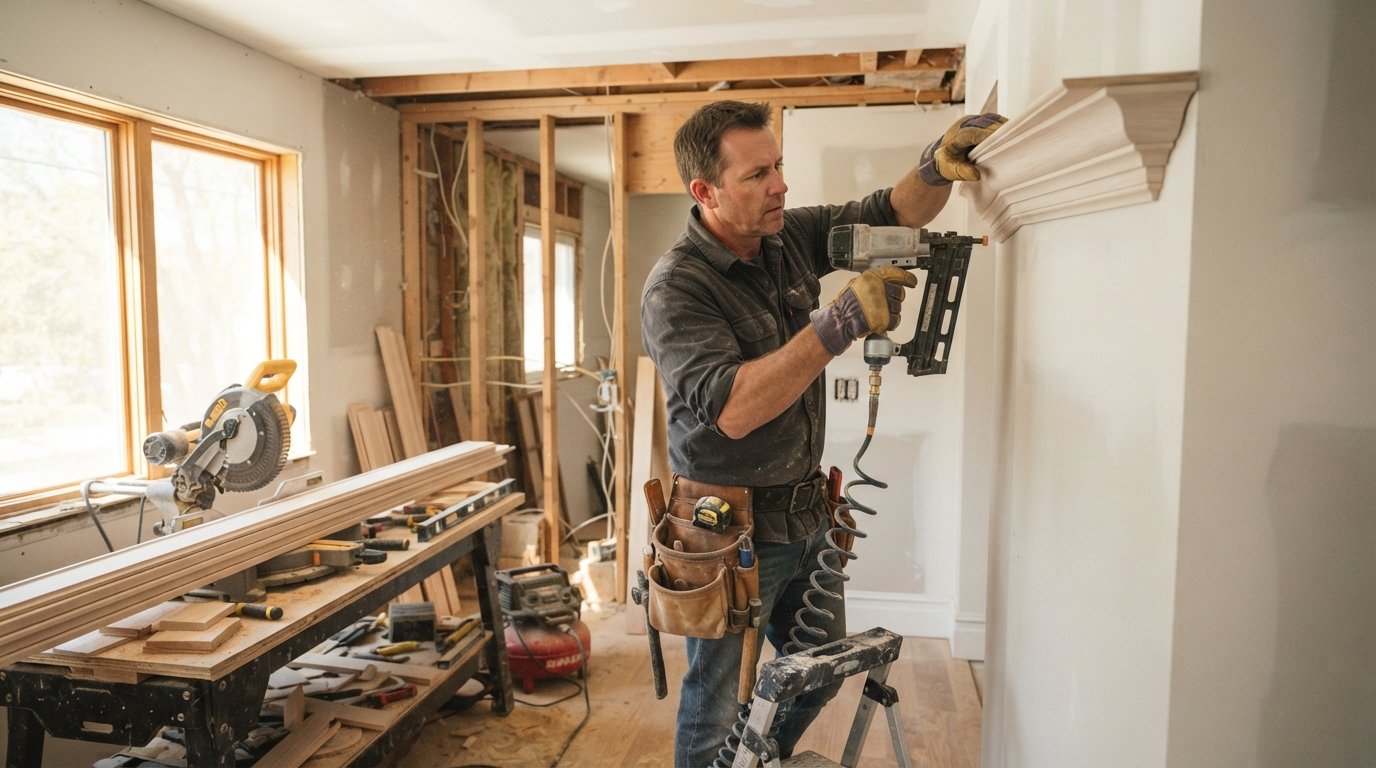
Finish carpentry is the final phase. It happens after drywall is installed and painted, and after flooring is laid. Finish carpenters work with higher-grade materials, such as solid hardwood, MDF, and pre-hung doors. They install trim, baseboards, crown molding, window and door casings, stair railings, and built-in furniture. Finish carpentry requires a keen eye for detail and precision. A gap in a mitered corner or a misaligned cabinet door is immediately visible and can ruin the look of an entire room. Because finish carpentry is the last step, mistakes can be costly to fix, so it is worth hiring an experienced craftsman.
Both types of carpentry require different skill sets. A rough carpenter needs to understand structural loads, building codes, and framing techniques. A finish carpenter needs patience, precision, and a good aesthetic sense. Some carpenters are skilled in both, but many specialize. When planning your remodel, ask your contractor which type of carpenter will be working on each phase. This ensures you get the right expertise for the job.
Key Carpentry Tasks in Common Remodeling Projects
Carpentry services vary depending on the type of remodel. Here is a breakdown of common projects and the carpentry work they involve. In a kitchen remodel, carpenters install cabinets, build islands, add crown molding, and trim out windows and doors. They may also frame new walls if you are changing the layout. In a bathroom remodel, carpenters frame walls, install subfloors, build vanity cabinets, and add trim. They might also build custom niches or shelving. In a basement finishing project, carpenters frame walls, install ceilings, build stairs, and add trim and doors. In an outdoor living space, carpenters build decks, pergolas, and porches.
Beyond these, carpenters also handle repairs and upgrades. If you have squeaky floors, a carpenter can reinforce the subfloor. If your doors stick, a carpenter can adjust the frames. If you want to add a closet organizer, a carpenter can build custom shelving. Carpentry is also essential for aging-in-place modifications, such as installing grab bars, ramps, and wider doorways. Whatever your remodeling goal, there is likely a carpentry component.
Here are some of the most common carpentry tasks you might encounter in a home remodel:
- Framing new walls, floors, and ceilings
- Installing windows, doors, and skylights
- Building and installing cabinets and vanities
- Adding trim, baseboards, and crown molding
- Constructing stairs, railings, and balusters
- Building custom built-ins, shelving, and storage
- Repairing or replacing damaged woodwork
Each of these tasks requires specific skills and tools. For example, installing a pre-hung door requires knowledge of framing, shimming, and insulation. Building custom cabinets requires precision cutting and joinery. When you hire a carpenter, ask about their experience with the specific tasks your project requires. A carpenter who excels at framing may not be the best choice for intricate trim work, and vice versa.
How to Hire the Right Carpentry Professional
Hiring the right carpenter is crucial for a successful remodel. Start by asking for recommendations from friends, family, and neighbors who have recently remodeled. You can also use a platform like USremodel to connect with vetted contractors in your area. Once you have a list of candidates, check their licenses, insurance, and references. A legitimate carpenter should carry general liability insurance and workers compensation insurance. If they are not insured, you could be held liable for accidents on your property. Also, check if your state or local jurisdiction requires a contractor license for carpentry work. Many states do not require a specific carpentry license, but they may require a general contractor license for projects above a certain dollar amount.
Next, ask for a detailed written estimate. The estimate should include labor, materials, timeline, and payment schedule. Be wary of estimates that are significantly lower than others, as they may indicate the carpenter is cutting corners or using inferior materials. Also, ask about the warranty on their work. A good carpenter will stand behind their craftsmanship for at least a year. Finally, trust your instincts. If a carpenter is unresponsive, evasive, or pushy, look elsewhere. You want someone who communicates clearly and respects your home.
When you are ready to get quotes, consider using a service that connects you with multiple contractors. 180 Remodel is a home remodeling and renovation contractor that helps homeowners find professionals for a wide range of projects, including carpentry. By getting multiple quotes, you can compare prices and services, and choose the best fit for your budget and needs.
Cost of Carpentry Services: What to Expect
The cost of carpentry services varies widely based on your location, the scope of work, the materials you choose, and the carpenter's experience. On average, homeowners pay between $50 and $100 per hour for carpentry labor. For larger projects, carpenters may charge by the square foot or by the linear foot. For example, installing baseboards might cost $3 to $6 per linear foot, while building custom cabinets could cost $500 to $1,500 per linear foot. Rough framing for an addition might cost $10 to $20 per square foot. These are just ballpark figures; actual costs depend on your specific project.
Materials also add to the cost. Solid hardwood is more expensive than MDF or plywood. Custom millwork costs more than off-the-shelf trim. If you are on a tight budget, you can save money by choosing standard sizes and materials, or by doing some of the prep work yourself, such as demolition. However, avoid cutting corners on structural carpentry, as it can compromise safety. It is always better to invest in quality workmanship and materials for the parts of your home you cannot see.
To get a accurate estimate for your project, it is best to consult with a professional. Many contractors offer free estimates. You can also use online calculators to get a rough idea, but keep in mind that these are not a substitute for a professional assessment. When comparing quotes, look at the total value, not just the price. A slightly higher quote from a reputable carpenter may save you money in the long run by avoiding costly mistakes and repairs.
DIY vs. Professional Carpentry: Making the Right Choice
Some homeowners are tempted to tackle carpentry projects themselves to save money. While DIY can be rewarding for small tasks like installing a shelf or replacing a piece of trim, it is not advisable for major remodeling work. Carpentry requires specialized tools, knowledge of building codes, and years of experience. A mistake in framing can lead to structural failure. A poorly installed cabinet can fall off the wall. A misaligned door can let in drafts and increase energy bills. Moreover, many municipalities require permits for structural work, and DIY work may not pass inspection.
Professional carpenters bring several advantages. They have the right tools and equipment, which they maintain and use safely. They know how to interpret blueprints and building codes. They work efficiently and can complete projects faster than most homeowners. They also carry insurance, so you are protected if something goes wrong. Perhaps most importantly, they have the skill to ensure a high-quality finish that enhances your home's value and appearance. For these reasons, it is almost always worth hiring a professional for any carpentry work beyond basic repairs.
If you do decide to hire a professional, be clear about your expectations. Provide detailed drawings or inspiration photos. Discuss the timeline and budget upfront. And make sure you understand the scope of work. A good carpenter will keep you informed throughout the project and address any concerns promptly. By working together, you can achieve a beautiful remodel that meets your needs.
In conclusion, carpentry services are an essential part of any home remodeling project. From the structural framework to the finishing touches, carpenters bring your vision to life. By understanding the different types of carpentry, knowing what to expect in terms of cost, and hiring a qualified professional, you can ensure your remodel is safe, beautiful, and built to last. Whether you are updating a single room or renovating your entire home, investing in quality carpentry is an investment in your home's future.
Learn more about General Carpentry for guides, costs, and what to expect.
Compare General Carpentry Pros Near You
Enter your ZIP code to compare top-rated local professionals and request free quotes.